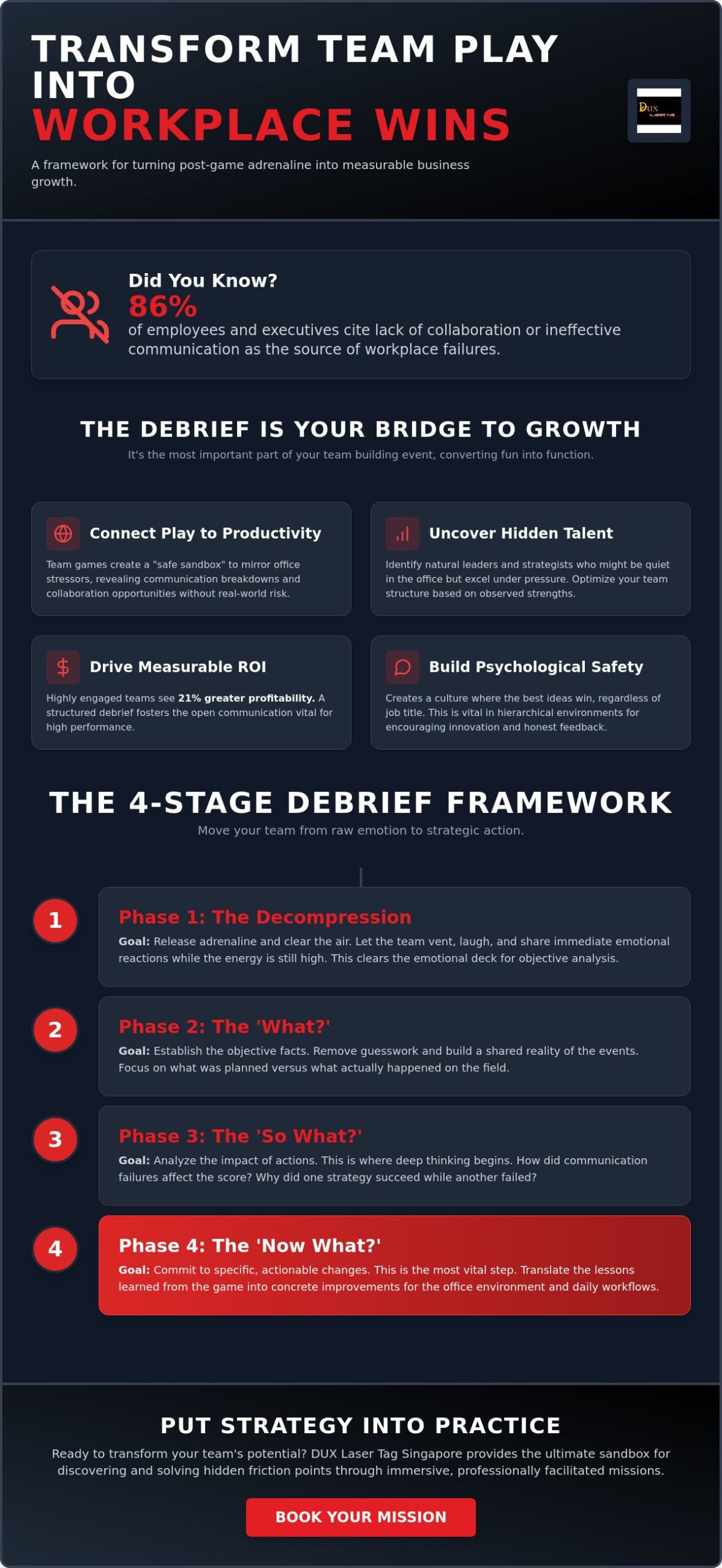
Did you know that 86% of employees and executives attribute workplace failures to a lack of collaboration or ineffective communication? You have likely felt that awkward silence after a high-octane round of Mobile Laser Tag when you ask the team what they learned. It is frustrating to see a massive investment in fun feel like “just a game” with no impact on your actual KPIs. You want the adrenaline to fuel real growth, not just provide a temporary break from the office.
We are here to help you master the art of the post-game discussion. Finding the right debrief questions after a team building game is the secret to turning tactical wins into lasting workplace improvements. This article provides a structured framework and 35 specific questions designed to trigger deep thinking and improve team trust. You will learn how to connect the strategy used in Archery Tag directly to your Monday morning productivity. Get ready to transform your next event into a strategic business win with these proven, high-energy conversation starters.
Key Takeaways
- Learn how to bridge the gap between high-energy play and professional growth by turning game-day adrenaline into permanent workplace improvements.
- Discover a tactical 4-stage framework designed to move your team from raw emotional reactions to concrete, data-driven facts.
- Access a categorized list of 35 debrief questions after a team building game to target specific goals like leadership and crisis communication.
- Master proven techniques to overcome the “Paiseh” factor and manage dominant voices so every team member contributes to the discussion.
- Find out how professional facilitation and immersive missions provide the perfect “sandbox” for uncovering and solving hidden friction points.
Why the Debrief is the Most Important Part of Your Team Building
The mission is over. The blasters are down. Your team is buzzing with adrenaline from a high-intensity session of Mobile Laser Tag. But here is the hard truth: the real victory happens after the game ends. Without a structured conversation, that high-energy buzz evaporates by the next morning. You need the debriefing process to lock in those lessons. It is the bridge between a fun afternoon and a high-performing quarter. It turns a temporary “high” into a permanent shift in how your team operates.
Think of the game as a safe “sandbox.” In this controlled environment, teams face friction points that mirror real office stressors. Did someone go rogue during the mission? Did communication break down under fire? The debrief allows you to address these issues without the high stakes of a client deadline. It justifies your corporate spend by transforming a “fun day out” into a strategic development session. Using the right debrief questions after a team building game ensures every tactical move becomes a professional breakthrough. You don’t want to leave your team’s growth to chance. Capture the data while the experience is fresh!
Connecting Play to Workplace Productivity
Games like Archery Tag or Corporate Laser Tag create simulated pressure. This mirrors the heat of a tight project deadline. When the “enemy” is closing in, how does your team react? Use the game as a powerful metaphor for cross-departmental collaboration. If the front-line shooters didn’t talk to the back-end defenders, the mission failed. It is exactly the same in the office. These sessions also reveal natural leaders. Sometimes the quietest analyst becomes the most effective strategist in the field. Identifying these traits helps you optimize your team structure back at the desk. You are not just playing; you are scouting for talent and refining your workflow under pressure.
The ROI of Reflection for Singapore Corporates
Singapore’s business culture thrives on efficiency and measurable growth. A structured feedback session aligns perfectly with this high-performance mindset. Global leaders use “After-Action Reviews” (AAR) to sharpen their competitive edge. Why should your team be any different? Research from Careertrainer.ai shows that companies with highly engaged teams see 21% greater profitability. By asking specific debrief questions after a team building game, you encourage open communication. This is vital in environments where hierarchy might usually stifle new ideas. It creates a culture where the best strategy wins, regardless of job title. You are building a legacy of success, one mission at a time. Make every minute count!
The 4-Stage Framework for a Successful Team Debrief
The mission is over, but the real work is just beginning! You need a rock-solid framework for a successful team debrief to capture the magic of the moment. Don’t just wing it. A structured approach ensures you don’t miss the critical “aha!” moments that happen in the heat of battle. We use a high-impact, four-stage process that moves your squad from raw emotion to strategic action. It is the only way to ensure the lessons stick long after the blasters are packed away.
- Phase 1: The Decompression. Let them vent! Your team is sweating, laughing, and maybe a little frustrated. This phase is about releasing the adrenaline and clearing the air.
- Phase 2: The ‘What?’. Establish the objective facts. What was the plan? What actually happened on the field? This stage removes the guesswork and builds a shared reality.
- Phase 3: The ‘So What?’. This is where the deep thinking begins. You analyze the impact of those actions on the team’s success. If the communication failed, how did that affect the score?
- Phase 4: The ‘Now What?’. This is the most vital step! You commit to specific changes in the office environment based on what you just learned.
By following this sequence, you avoid the trap of jumping to conclusions too quickly. You give everyone a voice and ensure the feedback is grounded in what actually happened, not just how people felt. It is a tactical approach to growth that mirrors the precision of our Corporate Laser Tag missions.
Step 1 & 2: From Adrenaline to Analysis
Start by allowing team members to celebrate big wins or laugh off “defeats” while the energy is still high. It is crucial to clear the emotional deck before asking serious debrief questions after a team building game. Once the noise dies down, pivot to gathering objective data. Ask about the strategy. Did it work? Did the team pivot when the plan failed? Ensure everyone’s perspective is heard. The intern might have seen a tactical opening that the manager missed. This creates a level playing field where data, not hierarchy, drives the conversation.
Step 3 & 4: Applying Lessons to the Office
Now, bridge the gap to the real world. Identify which behaviors from the game should be “imported” to your workplace immediately. If the team excelled at rapid-fire updates during a chaotic mission, how can you replicate that during a high-pressure product launch? Set “Micro-Commitments” for the following work week. These are small, actionable changes that keep the momentum alive. Close the session on a high note! You want your team leaving with a sense of accomplishment and a clear plan for Monday morning. This is how you turn a single afternoon of play into a year of peak performance.
35 Categorized Debrief Questions for Every Team Goal
Ready to turn that battlefield victory into a boardroom win? You need the right tools to extract the gold. A meta-analysis published in the journal ‘Human Factors’ reveals that using structured debrief questions can boost team performance by 20% to 25%. That is a massive competitive advantage. Don’t settle for “did you have fun?” when you can dive into the tactical “why” behind every move. These debrief questions after a team building game are designed to pierce through the surface and get your squad thinking like a high-performance unit.
Questions for Communication and Collaboration
Communication is the lifeblood of any mission. During a chaotic round of Mobile Laser Tag, clear signals make the difference between a win and a wipeout. Use these questions to analyze how your team shares data under fire. Focus on the transition from the field back to your daily digital tools like Slack or email.
- What was the most effective way we shared information during the heat of the game?
- Were there any moments where communication broke down? What caused it?
- How did we handle conflicting instructions during the chaos?
- Did anyone feel unheard during the strategy phase?
- How can we use these same communication channels in our daily updates?
- What “noise” can we eliminate from our office communication based on today?
- Who was the most consistent “information hub” during the mission?
Questions for Leadership and Accountability
Leadership isn’t just about a title; it is about action. Games like Archery Tag often reveal “natural leaders” who step up when the pressure is on. These questions help you identify those traits and build a culture of mutual accountability without the usual office friction.
- Who took charge when the original plan failed, and why?
- How did the team react to a change in leadership during the mission?
- What qualities did the “winning” leaders demonstrate that we admire?
- How do we hold each other accountable for our roles without creating conflict?
- When did a leader successfully pivot the team’s strategy?
- Did leadership styles change as the game progressed?
- How can we empower more team members to take initiative in the office?
Strategy, Trust, and Problem-Solving
The final pieces of the puzzle involve deep trust and tactical flexibility. Use these debrief questions after a team building game to explore the “So What?” of your session. These questions bridge the gap between individual effort and collective success.
- Strategy: Did we focus more on individual glory or the team mission? What was the turning point where we changed our tactics? Did we underestimate the “enemy”?
- Trust: When did you feel most supported by your teammates? Was there a moment you had to rely entirely on someone else’s “cover”? How do we build that same trust in our project teams?
- Problem-Solving: What was the most creative solution we used today? How did we handle a sudden loss of “equipment” or players? What would we do differently if we played again right now?
You now have a full arsenal of questions to drive real results. Don’t let the lessons escape! Pick the categories that align with your current KPIs and watch your team’s synergy explode.
Overcoming Common Debriefing Challenges
Even with a killer list of debrief questions after a team building game, you might hit a wall. In Singapore, the “Paiseh” factor often keeps the best ideas locked away. Team members might feel shy or worry about speaking out of turn. On the flip side, a dominant voice can quickly hijack the session. This turns a group reflection into a solo performance. You need to crush these obstacles fast to keep the momentum. An effective debrief doesn’t need to take an hour. You can drive massive results in just 15 minutes if you stay tactical and focused on the mission.
Facilitation Techniques for Inclusive Discussions
Start by using the “Think-Pair-Share” method. Ask a question and let everyone think for 30 seconds. Then, have them discuss it with just one partner. This lowers the stakes and gives quieter individuals the confidence to speak up. It’s a game-changer for engagement! If the conversation drifts into off-topic gripes, use the “Parking Lot” method. Write those points down for later and get back to the strategy. Don’t let the energy dip. Use physical movement to keep the blood pumping. Have the team “vote with their feet” by moving to different sides of the room based on their answers. This keeps the high-octane spirit of Archery Tag alive during the analysis.
Managing Conflict and ‘The Blame Game’
Tactical failures happen. It’s part of the game! But you must prevent the discussion from turning into a finger-pointing session. Reframing is your best weapon. Instead of asking “Who missed their shot?”, ask “How could we have supported that role better during the ambush?” Shift the focus from the individual to the system. Was the communication plan too complex? Did the team lack a clear backup strategy? This approach builds trust and encourages honest reflection without the fear of judgment. It ensures the session remains a safe “sandbox” for growth rather than a source of office tension.
Mastering these nuances is key to a high-impact event. For a deeper dive into planning your next session, check out The Ultimate Guide to Corporate Team Building Activities in 2026. It provides the broader context you need to align your games with long-term company goals. Ready to see these strategies in action? Book your next Corporate Laser Tag mission today and let our expert facilitators handle the heavy lifting! We don’t just run the game. We ensure every player finds their voice and every failure becomes a tactical win for your business.
Put Strategy into Practice with DUX Laser Tag Singapore
Ready to move from theory to tactical reality? DUX Laser Tag Singapore is your ultimate partner in professional adventure. We don’t just run games. We create high-stakes environments that generate real-time data for your growth. Every mission is a live case study in how your team handles pressure, conflict, and victory. This isn’t just about fun; it’s about building a more resilient, communicative, and agile workforce.
Our professional facilitators are experts at spotting the “aha!” moments as they happen. We watch the dynamics unfold and help you select the most impactful debrief questions after a team building game to ask your squad. We bring the tactical arena directly to you! Whether it is your office parking lot or a local park, our mobile setups mean you can go from the boardroom to the battlefield in minutes. It is convenient, thrilling, and designed for maximum impact.
High-Stakes Missions for High-Performance Teams
We offer customizable game modes that test specific soft skills. Our “Domination” and “Medic” modes are legendary for forcing teams to communicate under extreme pressure. In “Domination”, teams must hold a central point, requiring constant tactical updates and resource management. “Medic” modes test trust and protection, as players must defend a specific teammate to stay in the game. These scenarios provide a perfect stress-testing tool for both fast-moving startups and established MNCs.
Check out our Laser Tag Singapore guide to see how these epic missions are structured for 2026. Our corporate experience is the definitive bridge where high-octane adrenaline meets professional team alignment. You won’t just learn about strategy; you will live it.
Ready to Transform Your Team?
Booking your next session is fast and easy. We work closely with HR managers to ensure the event hits every one of your specific KPIs. We can even help you tailor your debrief questions after a team building game to address current office challenges or upcoming project goals. Our team handles the logistics, the equipment, and the facilitation, leaving you free to focus on your people. It’s time to stop talking about teamwork and start experiencing it. Explore our Corporate Laser Tag packages and secure your date today. Let’s make your next team building event the one they talk about for years!
Transform Game-Day Energy into Monday-Morning Results
You now have the ultimate toolkit to bridge the gap between heart-pounding play and peak professional performance. By mastering the 4-stage framework and deploying targeted debrief questions after a team building game, you ensure every tactical mission translates into real-world growth. You’ve learned how to crush the “Paiseh” factor and turn tactical failures into strategic wins. Don’t let your next event be just another day out of the office. Make it the catalyst for a more engaged, communicative, and profitable culture.
DUX Laser Tag Singapore is ready to deliver this high-impact experience directly to your doorstep. Our professional facilitators are trained in After-Action Review (AAR) techniques to help your team uncover its full potential. With flexible mobile setups that come to your preferred location and custom missions designed for corporate soft-skill development, we provide the perfect arena for your success. Book Your Next Corporate Adventure with DUX Laser Tag Singapore! Let’s create lasting memories and a stronger squad together!
Frequently Asked Questions
How long should a team building debrief session last?
A high-impact debrief should last between 15 and 30 minutes. You want to strike while the iron is hot! Keeping the session punchy ensures you capture the adrenaline-fueled insights without letting the energy drag. For a tactical session like Mobile Laser Tag, 20 minutes is usually the sweet spot to move from raw feelings to concrete office actions.
What if the team had a bad experience or lost the game badly?
Celebrate the failure as your best teaching tool! A “loss” provides the richest data for your debrief questions after a team building game. Shift the focus from individual mistakes to systemic breakdowns. Ask how the team can support each other better next time. It is a safe sandbox to fix communication gaps that might be hurting your real-world KPIs.
Can I run a debrief session for a very large group of 50+ people?
Yes, but you must break them into smaller “squads” of 8 to 10 people first. Large groups often trigger the “Paiseh” factor where only the loudest voices are heard. Let each squad run a mini-debrief for 10 minutes. Then, have one representative from each group share their single most tactical takeaway with the entire room to close the session.
What are the best ice-breaker questions before the debrief begins?
Start with high-energy “Decompression” questions to vent the adrenaline. Ask things like, “What was the most epic move you saw during that mission?” or “Who totally surprised you with their strategy?” These questions get the team laughing and celebrating wins. It builds a positive atmosphere before you pivot to the serious business lessons.
How do I transition from the fun of the game to the seriousness of the debrief?
Use a clear verbal “reset” to signal the change in focus. Gather everyone in a circle and acknowledge the excitement first. You can say, “That was an incredible round! Now, let’s take 15 minutes to figure out how we can use that same intensity to crush our next project launch.” This bridges the gap between play and productivity instantly.
Should the boss lead the debrief session or an external facilitator?
An external facilitator is often the better choice to ensure an even playing field. When the boss leads, some team members might hold back to avoid looking “unprofessional.” A neutral expert can ask the tough debrief questions after a team building game without any office politics getting in the way. It encourages total honesty and deeper trust.
What is the ‘What? So What? Now What?’ model in team building?
This is a tactical three-step framework for reflection. “What?” establishes the objective facts of what happened during the game. “So What?” analyzes why those actions led to a win or a loss. “Now What?” identifies the specific micro-commitments the team will make to improve their performance back at the office on Monday morning.
How do I handle a team that is too tired to talk after an active game?
Provide water and a five-minute “cool down” period before you start. If they are truly exhausted after a round of Archery Tag, keep the debrief physical. Use “voting with your feet” or quick “thumbs up” signals to gather data. You don’t need long speeches to get great results. Keep the rhythm brisk and focus on the most high-impact lessons!