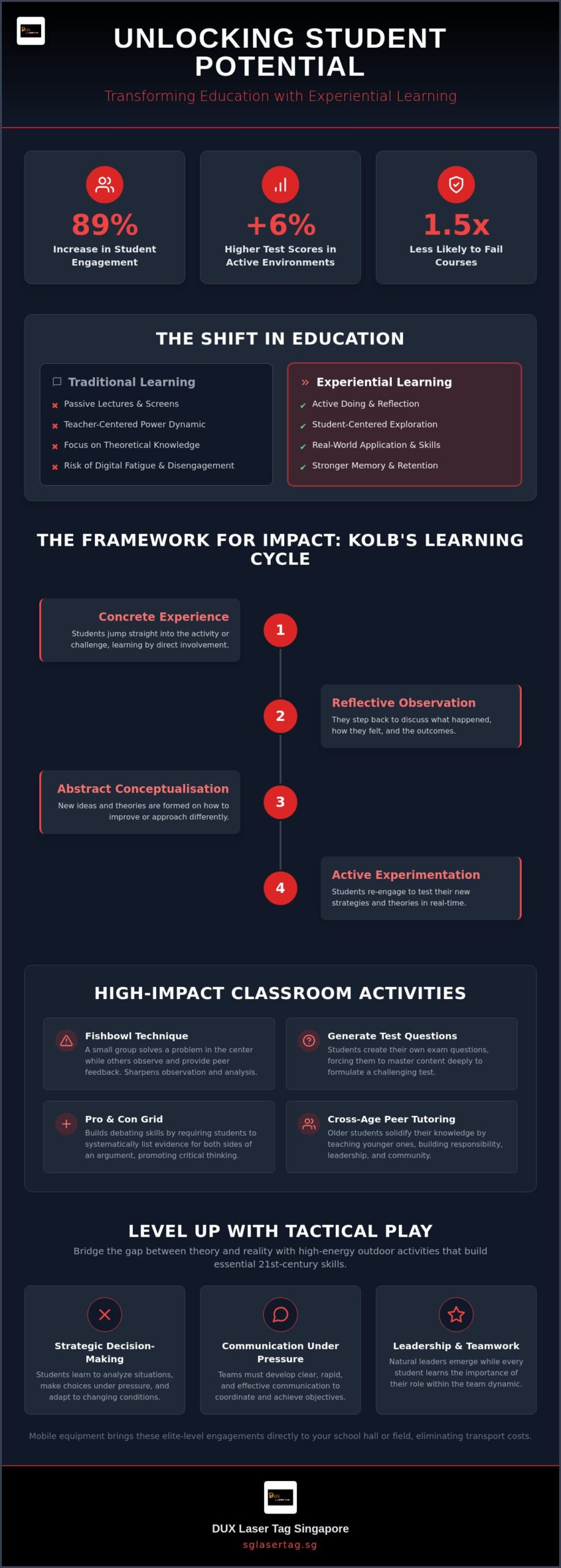
Did you know that experiential learning increases student engagement by a staggering 89%? It’s time to stop fighting for attention and start leading the charge. We understand the pressure of hitting MOE character development goals while students drift off during traditional lectures. You need results that show up in student behavior and grades. This guide reveals how to use experiential learning activities for students to turn your classroom into a high-energy zone where soft skills like leadership and communication actually stick.
Research shows students in active environments see 6% higher test scores and are 1.5 times less likely to fail. That’s a massive win for any educator. We’re showing you how to ditch the desk and embrace tactical, immersive experiences that require real strategy. You’ll discover budget-friendly, mobile-ready ideas that bring the adventure directly to your school hall. Get ready to see visible improvements in teamwork and problem-solving as we dive into the best ways to engage your students in 2026.
Key Takeaways
- Master the four stages of Kolb’s Cycle to transform simple tasks into powerful, reflective learning cycles that ensure long-term knowledge retention.
- Implement low-cost, high-impact experiential learning activities for students like the Fishbowl technique to sharpen observation and peer feedback skills.
- Unlock student potential through tactical outdoor play that bridges the gap between abstract leadership theory and real-world strategic decision-making.
- Learn the professional blueprint for facilitating safe, inclusive, and curriculum-aligned adventures that meet MOE character development goals.
- Eliminate logistical headaches and transport costs by utilizing mobile equipment that brings elite-level engagement directly to your school hall or field.
What is Experiential Learning and Why Does it Work?
Digital fatigue is hitting hard in 2026. Students are tired of passive screens and long-winded lectures. They need movement. They need impact. Experiential learning is the process of learning through reflection on doing. It shifts the power from the teacher at the front to the student in the heat of the action. This student-centered approach isn’t just a trend; it’s a necessity for modern education. It transforms the classroom from a room of listeners into a lab of explorers.
To make this work effectively, we use Kolb’s Cycle. This four-stage framework ensures that experiential learning activities for students aren’t just “fun” but actually educational. It follows a rhythmic flow that locks in knowledge:
- Concrete Experience: Students jump straight into the activity or challenge.
- Reflective Observation: They step back to discuss what happened and how they felt.
- Abstract Conceptualisation: They form ideas and theories on how to improve.
- Active Experimentation: They jump back in to test their new strategy in real-time.
The Science of Retention: Learning by Doing
Active participation triggers deep emotional engagement. When students are physically involved, their brains create stronger memory anchors that lead to better retention. This is why experiential learning activities for students are so effective for long-term mastery. Fail-safe environments allow students to take risks. They can fail, pivot, and succeed without the crushing weight of a permanent red mark on their paper. Experiential learning serves as a vital bridge between theoretical classroom knowledge and real-world application.
Soft Skills vs. Hard Facts
Character building is the backbone of the 2026 curriculum. Academic scores only tell half the story. We need to develop 21st-century competencies like critical thinking, collaboration, and rapid communication. Tactical games act as a microcosm of society. In these high-energy simulations, students must communicate under pressure. They learn to lead. They learn to follow. These activities build the soft skills that textbooks simply can’t reach. It’s about turning “I know this” into “I can do this” through direct, pulse-pounding experience.
Top Classroom-Based Experiential Learning Activities
You don’t need a massive field to spark a revolution. While outdoor adventures are peak experiences, daily experiential learning activities for students can start right at their desks. Focus on shifting from passive listening to active doing. Give your students the driver’s seat and watch their engagement skyrocket.
Use the Fishbowl technique to sharpen observation. Place a small group in the center to solve a problem while the rest of the class analyzes their process. It creates a high-stakes environment for peer feedback without leaving the room. It’s fast. It’s intense. It works. Students learn to critique constructively while witnessing real-time problem-solving in action.
Flip the script on assessments. Ask students to generate their own test questions. To write a killer question, they must master the content first. It’s a simple, high-impact way to ensure deep comprehension. Pair this with a Pro and Con Grid to build debating muscles. Instead of a messy argument, students must systematically list evidence for both sides. It forces them to think critically before they speak.
Cross-age peer tutoring is a massive win for 2026. When older students teach younger ones, they solidify their own knowledge. It builds a sense of responsibility and community across the school. It turns every student into a leader and ensures that character development isn’t just a theory, but a daily practice.
Gamifying the Curriculum
Role-play brings history to life. Don’t just read about the Industrial Revolution. Let students simulate a factory floor. Use the Mnemonic Master challenge to turn facts into competitive memory games. These experiential learning activities for students turn dry subjects into high-stakes missions. If you want to take this energy higher, consider how school laser tag programmes reinforce these tactical lessons on a larger scale.
Interactive Problem Solving
Launch a design thinking workshop using simple materials like cardboard and tape. It’s fast, messy, and brilliant for innovation. Try the Mystery Box challenge to boost inductive reasoning. Students must guess objects using limited clues. Break your learning objectives into short, 15-minute high-impact sprints. This keeps adrenaline high and prevents digital fatigue. Focus on constant movement and rapid iteration.
High-Energy Outdoor Activities: Tactical Play as a Classroom
Physical movement is the ultimate cognitive catalyst. Research shows that students in active environments are 1.5 times less likely to fail. Why? Because movement forces the brain to engage with the environment in real-time. This is where experiential learning activities for students truly shine. Tactical play turns a field or school hall into a high-stakes laboratory. It isn’t just about running around. It’s an immersive mission where every decision has an immediate consequence. When students are physically active, they unlock cognitive potential that stays dormant behind a desk.
Tactical laser tag serves as a perfect simulation for leadership. Students aren’t just playing a game; they’re managing resources and executing complex strategies under pressure. You can also introduce combat archery to focus on resilience and precision. Even inflatable snooker plays a vital role. It blends physical coordination with geometry and logic. It turns abstract math into a tangible, high-energy challenge. These activities provide the adrenaline boost students crave while delivering the deep learning outcomes educators need. It’s about making lessons feel like adventures.
Strategic Mission Scenarios
Mission design is the secret to success. Take ‘Capture the Flag.’ It’s a masterclass in resource management and division of labour. Who stays to defend? Who pushes forward? Students must decide instantly. Use ‘VIP Protection’ modes to drive home concepts of empathy and collective responsibility. In these scenarios, the team is only as strong as its ability to protect its most vulnerable member. For a true test of trust, launch a ‘Night Mission.’ Low-visibility environments force students to rely entirely on verbal communication and their teammates’ locations. It builds bonds that a traditional classroom simply cannot replicate. These experiential learning activities for students ensure every participant has a vital role to play.
Character Building Through Tactical Games
Tactical play is a direct path to hitting MOE Character and Citizenship Education (CCE) goals. Engaging in laser tag singapore missions allows students to practice real-time emotional regulation. Adrenaline is high. The battlefield is loud. Students must manage their stress and communicate clearly even when things go wrong. This is where they learn the art of ‘losing well.’ Experiencing a tactical failure is a gift. It provides the perfect moment for reflection and pivot. These activities teach that failure isn’t the end. It’s just more data for the next mission. It builds the grit and resilience needed for life beyond the school gates. You aren’t just teaching a game. You are building future leaders.
How to Design and Facilitate an Experiential Programme
Design is the difference between a chaotic afternoon and a life-changing lesson. You aren’t just hosting a game; you’re building a strategic pathway to growth. Start by setting razor-sharp learning objectives before the first student even hits the field. What is the ultimate mission? If you’re focusing on leadership, design scenarios where the leader must delegate to succeed. If it’s about communication, create challenges that limit verbal cues. High-quality experiential learning activities for students must be inclusive. Every participant, regardless of their fitness level or athletic ability, needs a role that feels essential to the team’s success.
Scaling these programs requires professional precision. Whether you are managing a single class of 30 or a massive cohort of 300, the structure must remain rhythmic and tight. Break large groups into smaller tactical squads to keep the energy high and the downtime low. This ensures every student stays in the “flow state” where deep learning occurs. Use mobile setups to turn any available space into a professional arena instantly.
The 3-Step Facilitation Framework
Master the three-step flow to guarantee results. First, the Brief. This isn’t just a rule dump. It’s about setting the “mission mindset.” Use high-energy language to build anticipation and clarify the stakes. Second, the Action. This is the hardest part for many educators: step back. Allow the students to lead, struggle, and even fail. If you step in too early, you rob them of the “Active Experimentation” phase of the learning cycle. Let them feel the consequences of their tactical decisions in real-time.
Finally, the Debrief. This is the most critical stage. Use the “What? So What? Now What?” model to trigger deep reflection. Ask students what happened during the mission. Push them to analyze why their teamwork collapsed or succeeded. Then, ask how they will apply that lesson to their next project or classroom challenge. Reflection is where the pulse-pounding experience turns into lasting wisdom. Without this, it’s just a game. With it, it’s a transformation.
Safety and Logistics for School Groups
Safety is the foundation of every adventure. Conduct rigorous risk assessments for all outdoor and high-energy play zones. Professional school & moe laser tag programmes offer the gold standard here. They provide end-to-end facilitation and advanced infrared equipment that is safe for all ages. This removes the massive burden of equipment management and safety monitoring from your staff.
Mobile setups solve the biggest pain point for schools: transport. Bringing the battlefield to your school hall or field saves time and budget. You get a professional-grade arena without the logistical nightmare of a field trip. Ready to see the impact of professional facilitation? Inquire about our mobile school programmes to bring the adventure directly to your campus.
Why DUX Laser Tag Singapore is the Ultimate Partner for Schools
Choosing the right partner is the final step in launching successful experiential learning activities for students. You need more than just high-tech equipment. You need a team that understands MOE requirements and the high-energy needs of a modern youth cohort. DUX Laser Tag Singapore delivers a professional, end-to-end experience that removes every ounce of stress from the organizer. We don’t just provide a service; we act as your dedicated partner in adventure. From the first tactical briefing to the final reflective debrief, our facilitators ensure every mission aligns perfectly with your school’s character goals. Our staff are trained motivators who know how to manage large groups while keeping the adrenaline and focus at peak levels.
Our track record is built on reliability, safety, and pulse-pounding excitement. We understand that teachers are already pushed to the limit. Our goal is to take the planning burden off your shoulders completely. DUX Laser Tag Singapore handles the setup, the safety briefings, and the tactical facilitation with professional rigor. You get to step back and watch your students transform into leaders and strategists in real-time. It’s a seamless process designed for maximum impact and zero hassle. Every session is facilitated by experts who know how to motivate students while maintaining the high standards of safety required for MOE programmes.
Mobile Setups: Your School Field, Our Arena
Forget the logistical nightmare of booking buses and managing off-site permissions. DUX Laser Tag Singapore brings the battlefield directly to you. Our mobile setups are designed to transform any school hall or field into an immersive tactical zone in minutes. This eliminates transport costs and keeps your students on campus where they are most comfortable. It’s the ultimate solution for schools looking for experiential learning activities for students that fit perfectly into a standard timetable. Whether it’s a two-hour intensive or a full-day cohort camp, we adapt to your specific schedule. Our advanced infrared gear is safe, portable, and ready for action across the country. We provide the peak quality experience you expect without the logistics headaches that usually come with field trips.
Beyond Just Fun: The Educational Edge
We believe tactical play is the best way to teach 21st-century competencies. Every mission run by DUX Laser Tag Singapore is grounded in the same principles used in high-level corporate team building activities. We focus on communication, strategy, and resilience. Students must work together to overcome tactical hurdles, forcing them to practice soft skills in a high-stakes environment. This isn’t just about winning a game. It’s about learning to lead under pressure and supporting teammates through tactical failures. We turn the joy of play into a powerful educational tool that boosts retention and character development. Ready to transform your next school program? Book an epic experiential learning session for your school today!
Ignite Student Potential with Immersive Adventures
The future of education isn’t found in a textbook. It’s built through action. You’ve seen how physical movement triggers cognitive potential and how a structured debrief turns a simple game into a lifelong lesson. By choosing strategic experiential learning activities for students, you give them the tools to lead, communicate, and solve problems under pressure. It’s time to ditch the digital fatigue and bring the energy back to your campus!
We make the transition effortless. Our team provides professional facilitators for every session to ensure your learning goals are met with precision. We use advanced, safe infrared technology that works perfectly in any environment. Plus, our flexible mobile setups mean we bring the entire arena directly to your school hall or field. No buses. No logistics stress. We handle the heavy lifting so you can focus on seeing your students thrive.
Let’s create lasting memories and real character growth together. Your next epic adventure is just one click away!
Frequently Asked Questions
What are some examples of experiential learning activities for primary students?
Primary students thrive on tactile challenges like role-playing historical figures or building complex structures with simple household materials. You can also introduce high-energy play like inflatable snooker to teach basic geometry and coordination. These hands-on tasks keep energy high and focus sharp for younger learners who need constant engagement to stay on track.
How do experiential learning activities benefit students with different learning styles?
These activities provide a multi-sensory experience that caters to every student in your cohort. Kinesthetic learners engage through physical movement, while visual and auditory learners benefit from the immediate feedback and collaborative tactical discussions. It is the ultimate way to ensure no student is left behind, as everyone finds a role that matches their specific strengths.
Can experiential learning be used for complex subjects like science or history?
Absolutely! Use simulations to represent scientific processes or re-enact pivotal historical events to make abstract concepts feel real. experiential learning activities for students turn dry facts into immersive missions where they must apply complex theories to succeed. This approach moves beyond rote memorization and forces students to understand the “why” behind the facts.
How do I ensure student safety during high-energy physical activities?
Safety starts with professional facilitation and rigorous risk assessments of your school hall or field. Use advanced, safe infrared equipment that eliminates the risks of physical impact found in other sports. Professional instructors monitor every mission to maintain a controlled environment, ensuring the experience is both thrilling and perfectly safe for all age groups.
What is the best way to debrief an experiential learning session?
The “What? So What? Now What?” framework is the gold standard for triggering deep reflection after a mission. Start by asking students what happened during the activity, then push them to analyze why those results matter for their team. Finally, challenge them to apply those insights to their future classroom projects or personal leadership goals.
How much space is required for a mobile laser tag session at school?
We are incredibly flexible and can adapt to almost any campus layout! A standard school hall or half a football field is usually plenty of room to set up a professional tactical arena. Our mobile setups are designed to transform your existing space into a high-stakes environment without the need for any off-site transport or logistics.
Are DUX laser tag programmes aligned with MOE’s CCE goals?
Yes, our programmes are specifically designed to meet MOE’s Character and Citizenship Education (CCE) goals with professional precision. We focus on building leadership, resilience, and teamwork through high-energy tactical missions that require real communication. It is a practical, visible way to see student character development in action outside the traditional classroom setting.
How can I assess student progress during experiential activities?
Assessment happens through direct observation of teamwork and peer feedback during the tactical mission. You can also use reflective journals or “exit tickets” where students explain the specific strategy they used to overcome a challenge. These methods provide a clear view of how well they are mastering both soft skills and your specific curriculum content.